

AI is reshaping how small and mid-sized businesses collaborate with partners. Recent data shows AI enhances productivity in SMB partner ecosystems by 42% through automation and predictive analytics. Yet many executives underestimate how quickly AI delivers measurable returns in partner programs. This guide explains how AI fits into partner ecosystems, covering proven implementation methods, creative and security benefits, common risks, and actionable steps to unlock AI's full potential for your business partnerships.
Table of Contents
- Key Takeaways
- How AI boosts productivity and drives revenue growth for partners
- Implementing AI in partner programs: proven strategies and tools
- Enhancing creativity and boosting security with AI in partnerships
- Navigating risks and expert nuances in AI partnerships for SMBs
- Actionable steps to unlock AI's full value for partner ecosystems
- Explore Nobisys AI solutions to accelerate your partner ecosystem
- FAQ
Key Takeaways
| Point | Details |
|---|---|
| Productivity uplift 42 percent | AI drives a 42 percent productivity lift across partner ecosystems through automation and predictive analytics. |
| 90 day pilots | Begin with focused 90 day pilots on high ROI use cases such as lead scoring and support automation to demonstrate value quickly. |
| Structured roadmaps reduce risk | A strategy first phased roadmap approach reduces risk and accelerates time to value. |
| Governance and integration | Establish governance and integrate AI tools with existing PRM and CRM systems to prevent data silos and manage risk. |
How AI boosts productivity and drives revenue growth for partners
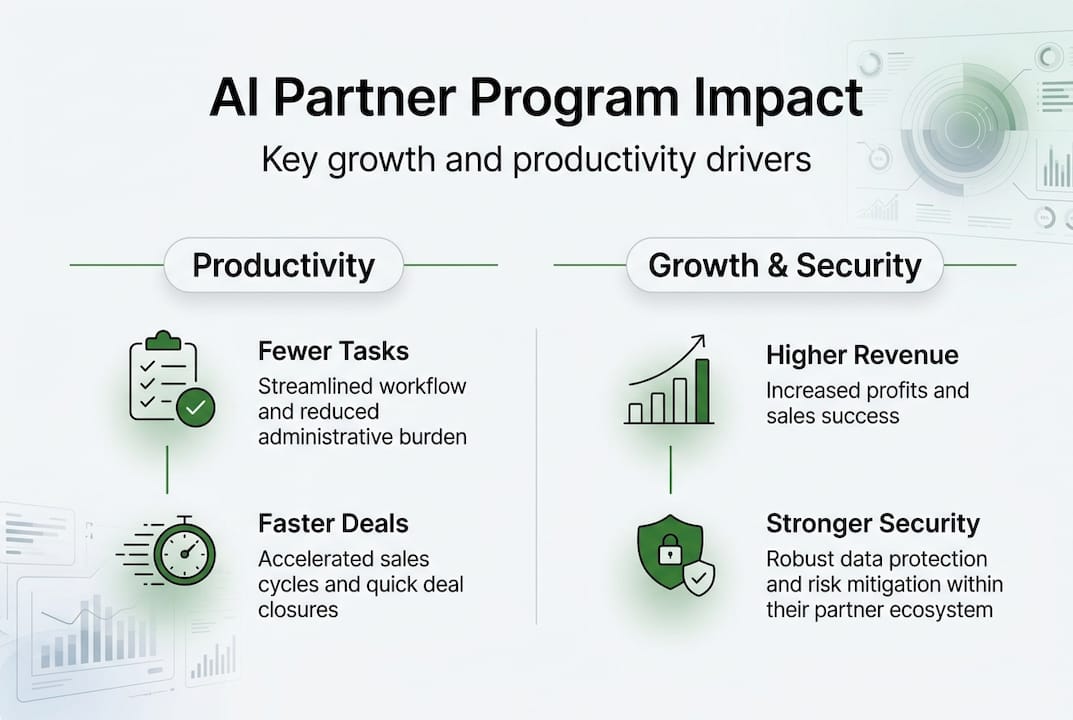
Automation eliminates repetitive tasks that consume valuable partner time. When AI enables 23% faster deal closure and saves 5.6 hours weekly, your teams redirect energy toward strategic activities that drive growth. Predictive analytics transforms lead scoring by identifying high-value prospects earlier in the sales cycle, accelerating conversions and improving resource allocation.
Personalized AI workflows adapt to each partner's unique needs and communication preferences. This customization strengthens collaboration while boosting revenue outcomes. SMBs implementing AI productivity case studies report consistent gains across multiple partnership functions, from onboarding to co-marketing campaigns.
Here's how AI impacts key partnership metrics:
- Time savings average 5.6 hours per week per partner manager
- Deal closure rates improve by 23% through better lead prioritization
- Overall productivity lifts reach 42% when combining automation with analytics
- Revenue growth accelerates by 27% as partners focus on strategic initiatives
| Partner program area | Hours saved weekly | Productivity lift | Revenue impact |
|---|---|---|---|
| Lead scoring and qualification | 3.2 | 38% | 21% increase |
| Partner onboarding | 2.1 | 45% | 18% increase |
| Co-marketing campaigns | 1.8 | 41% | 24% increase |
| Support and enablement | 2.5 | 52% | 32% increase |
Pro Tip: Begin with pilot projects targeting specific partner program areas like lead scoring and support automation. These deliver visible results within 90 days, building organizational confidence for broader AI adoption. Focus on AI solutions for partners that integrate seamlessly with your existing systems to minimize disruption during initial rollout phases.
The productivity gains compound as AI systems learn from partner interactions. Early adopters using AI implementation roadmaps report sustained performance improvements beyond initial deployment periods, creating lasting competitive advantages in their partner ecosystems.
Implementing AI in partner programs: proven strategies and tools
Successful AI adoption follows a structured methodology that reduces risk while accelerating time to value. Phased AI implementation involves strategy-first roadmaps that align technology choices with business objectives. This approach prevents common failures caused by tool-first thinking.
Here's your step-by-step implementation framework:
- Define clear goals and success metrics aligned with partner ecosystem objectives. Specify what productivity gains, revenue targets, or efficiency improvements matter most to your organization.
- Choose AI tools matching those goals. Consider conversational AI for partner communications and predictive analytics for forecasting and lead scoring.
- Develop prompt templates and workflows for onboarding, co-marketing, and sales enablement. Document these processes to ensure consistency across your partner network.
- Integrate AI tools with existing Partner Relationship Management and Customer Relationship Management systems. This connection ensures data flows seamlessly without creating information silos.
- Use maturity models to scale and refine AI adoption while monitoring data quality and governance. Regular assessments identify optimization opportunities and prevent technical debt.
The AI adoption methods you select should match your organization's technical capabilities and partner readiness levels. Some partners embrace new technology quickly while others require more gradual onboarding. Tailoring your approach to these differences increases overall ecosystem success rates.
Tool selection matters significantly. ChatGPT and Claude offer different strengths for various partnership tasks. Evaluate options based on integration ease, cost structure, and specific use case requirements. AI toolkits and integration resources help you compare capabilities and make informed decisions.
Prompt engineering deserves special attention during implementation. Well-crafted prompts produce consistent, high-quality outputs that partners trust. Invest time developing and testing templates before widespread deployment. This upfront work pays dividends through reduced errors and faster partner adoption.
Pro Tip: Avoid common pitfalls by following structured playbooks and establishing early feedback loops. 90-day AI pilots focusing on high ROI deliver results while minimizing failure risks for SMBs. These short-cycle projects let you validate assumptions, adjust strategies, and demonstrate value to stakeholders before committing to larger investments.
Maturity scaling requires ongoing attention to data quality and governance. As your AI systems process more partner information, maintaining accuracy becomes critical. Regular audits and quality checks prevent degradation that could undermine partner trust. Consider partner portfolio strategy implications as you scale, ensuring your AI capabilities match the sophistication levels across your entire partner ecosystem.
Enhancing creativity and boosting security with AI in partnerships
AI acts as a cybernetic teammate that complements human creativity in co-creation initiatives. Research shows AI outperforms humans in co-creation due to higher novelty and usefulness scores. Partners using AI collaboration tools generate more innovative solutions faster than traditional brainstorming approaches.

This creative enhancement extends across multiple partnership activities. Joint product development benefits from AI-generated concept variations that humans might not consider. Marketing campaigns gain fresh perspectives through AI-assisted content ideation. Strategic planning sessions become more productive when AI synthesizes market data and identifies emerging opportunities.
Security improvements prove equally transformative. Security Copilot reduces security alerts by 22.88% and incident reopens by 68.44%, significantly improving partner ecosystem security. These reductions let security teams focus on genuine threats rather than chasing false positives.
Key creativity benefits include:
- Speed improvements of 3-5x in generating initial concepts and variations
- Novelty scores 27% higher than human-only ideation sessions
- Accessibility for non-technical partners who can contribute ideas through conversational interfaces
- Consistency in quality across different partnership phases and team compositions
The security advantages extend beyond alert reduction. AI systems detect patterns humans miss, identifying sophisticated threats that traditional tools overlook. Response times improve dramatically when AI triages incidents and recommends remediation steps. Partners gain confidence sharing sensitive information knowing AI cybersecurity solutions protect their data.
AI-driven security monitoring cuts false alerts by nearly 23% while reducing incident reopening rates by over 68%, enabling partners to respond faster and more accurately to genuine threats.
Creative collaboration tools from AI creative collaboration tools providers adapt to different partnership styles and industry contexts. Some partners prefer structured workflows while others thrive with open-ended exploration. AI flexibility accommodates both approaches without forcing artificial standardization.
The combination of enhanced creativity and stronger security creates a powerful foundation for partner ecosystem growth insights. Partners feel safe experimenting with bold ideas knowing security systems protect their innovations. This psychological safety accelerates innovation cycles and strengthens long-term partnership commitment.
Navigating risks and expert nuances in AI partnerships for SMBs
High failure rates plague SMB AI initiatives. 67% of SMB AI projects fail due to poor problem definition and unclear objectives. Partnerships amplify these risks through ecosystem dependencies that create control loss and vendor lock-in scenarios.
Partnership dependencies introduce asymmetric risks that single-organization AI projects avoid. When your partner's AI capabilities falter, your operations suffer regardless of your own technical excellence. This interconnectedness requires careful portfolio management and contingency planning.
Readiness gaps compound the challenge. AI adoption optimism contrasts with readiness gaps as only 20% of partners are truly AI-ready. This disparity creates alliance risks including integration failures, data quality issues, and strategic misalignment.
| Factor | Optimism level | Actual readiness | Risk level |
|---|---|---|---|
| AI adoption intent | 78% of SMBs | 20% fully ready | High |
| Technical capability | 65% confident | 31% validated | Medium-high |
| Data governance | 71% planned | 18% implemented | High |
| Partner alignment | 82% expected | 23% confirmed | Very high |
Vendor lock-in emerges as a critical concern when partnerships center on proprietary AI platforms. Switching costs escalate quickly once you've integrated deeply with a partner's systems. This dependency limits your strategic flexibility and negotiating power over time.
Best practices for risk mitigation:
- Clarify problems before selecting solutions. Document specific challenges and success criteria to guide technology choices.
- Diversify partners across capability levels and specializations. Avoid over-reliance on any single partner for critical AI functions.
- Establish governance frameworks covering ethics, data quality, and decision rights. Clear policies prevent conflicts and ensure accountability.
- Conduct regular partner AI maturity assessments. Track progress and identify gaps requiring attention or alternative arrangements.
- Balance legacy partners with innovative startups in portfolios. Established players provide stability while agile firms drive innovation.
Pro Tip: Regularly evaluate partner AI maturity and balance legacy with innovative startups in portfolios. Partner portfolio management strategies help you optimize this mix for your specific industry and growth stage. Consider geographic and regulatory diversity to reduce concentration risks.
The AI risk mitigation tools market offers solutions for monitoring partner performance and detecting early warning signs. Automated dashboards track key metrics like integration health, data quality scores, and security posture. These insights enable proactive interventions before small issues become major problems.
Understanding AI adoption statistics helps you benchmark your partnership ecosystem against industry norms. If your partners lag significantly behind market averages, you face elevated risks requiring strategic adjustments. Conversely, leading indicators suggest opportunities to accelerate joint initiatives and capture competitive advantages.
Actionable steps to unlock AI's full value for partner ecosystems
Clarity drives success in AI partnerships. Start with objectives tied directly to partner ecosystem goals like revenue growth, cost reduction, or market expansion. Vague aspirations produce vague results while specific targets enable focused execution.
Your implementation roadmap should follow this sequence:
- Define measurable objectives aligned with partner ecosystem priorities. Specify the productivity gains, revenue targets, or efficiency improvements that justify your AI investment.
- Select AI tools matching those priorities and plan phased implementation. Avoid the temptation to deploy everything simultaneously. Staged rollouts reduce risk and allow learning between phases.
- Run targeted pilots focusing on high-impact uses. Prioritize 90-day AI pilots in impactful areas like lead scoring (boosting conversions 15%) and Tier 1 support automation (40-60% resolution rates).
- Continuously assess and iterate based on success metrics. Establish review cadences that catch issues early while celebrating wins that build momentum.
- Redesign partner portfolios blending established players with agile AI-native firms. This balance delivers innovation and resilience simultaneously.
- Focus governance on ethics, data quality, and dependency management. These foundations prevent problems that undermine long-term partnership value.
Lead scoring pilots demonstrate value quickly because results appear in conversion metrics within weeks. Partners see immediate benefits that justify broader AI adoption. Support automation similarly produces visible wins through reduced ticket volumes and faster resolution times.
AI pilot programs provide structured frameworks for these initial deployments. Templates and playbooks accelerate setup while reducing the learning curve for teams new to AI implementation. Pre-built integrations with common PRM and CRM systems eliminate technical barriers that slow progress.
Performance benchmarks guide your scaling decisions. AI performance benchmarks show what success looks like across different use cases and industries. Compare your results against these standards to identify optimization opportunities and validate that your implementations meet expectations.
Portfolio redesign requires strategic thinking about partner capabilities and market positioning. Partner portfolio strategy frameworks help you evaluate which partners bring complementary strengths versus redundant capabilities. This analysis informs decisions about deepening existing relationships or recruiting new partners with specific AI expertise.
Governance deserves ongoing attention as AI systems evolve. Ethics policies ensure your AI use aligns with organizational values and regulatory requirements. Data quality standards prevent garbage-in-garbage-out scenarios that erode trust. Dependency management protocols maintain your strategic flexibility as partnerships deepen.
Explore Nobisys AI solutions to accelerate your partner ecosystem
You've learned how AI transforms partner productivity, creativity, and security. Now it's time to put these insights into action with solutions designed specifically for SMB partner ecosystems. Nobisys offers comprehensive AI tools that deliver the benefits described throughout this guide.
Our AI core capabilities provide robust functionality proven to increase productivity by over 40% while strengthening security across your partner network. These aren't theoretical benefits. They're measurable outcomes from live deployments in real business environments.
Leverage AI prototyping solutions to pilot AI-driven workflows in your partner programs quickly. Our 90-day pilot frameworks help you validate ROI before committing to full-scale implementations. You'll see results in lead scoring, support automation, and co-marketing within your first quarter.
Design a balanced partner portfolio with partner portfolio management tools that optimize innovation and risk management. Our platform helps you assess partner AI maturity, identify capability gaps, and make strategic decisions about ecosystem composition.
FAQ
What is the main benefit of AI for partner ecosystems?
AI automates repetitive tasks, accelerates lead scoring by 23%, and fosters innovative collaboration among partners. These improvements translate into measurable productivity gains of 42% and revenue growth of 27%. Partners redirect saved time toward strategic activities that strengthen relationships and drive business outcomes.
How can SMBs start implementing AI in their partner programs?
Begin with clear goals and select AI tools aligned to those objectives. Pilot programs focusing on high-ROI use cases like lead scoring and Tier 1 support help validate benefits within 90 days. This approach builds organizational confidence while identifying scalability opportunities before full rollout.
What are common risks of AI partnerships SMBs should watch for?
High failure rates stem from unclear goals and dependencies on partners who may not be AI-ready. Only 20% of partners possess true AI readiness, creating integration and alignment challenges. SMBs should balance partner portfolios and enforce governance covering ethics, data quality, and vendor lock-in prevention.
How does AI improve security in partner ecosystems?
AI security copilots cut false alerts by 22.88% and incident reopenings by 68.44%. This enables partners to respond faster to genuine threats while reducing time wasted on false positives. Improved pattern detection identifies sophisticated attacks that traditional tools miss, strengthening overall ecosystem security posture.